
Rosenberg Court Docket Searches
Start with the official Rosenberg Municipal Court page. It links payment options and forms. What it does not offer is a general case-search screen. Before calling, gather the citation number. Also collect the exact cited name, the offense date, and the date printed on the notice. Then phone the clerk ahead of the court date. Rosenberg staff assign each appearance time rather than posting a set schedule.
- Confirm the citation names Rosenberg Municipal Court as the filing court.
- Keep both the citation number and any separate docket number shown on a notice.
- Call 832-595-3450 to obtain or confirm the assigned appearance time and current status.
- Use the city payment or form route only for the specific action it describes.
- Request the case file or disposition through the municipal court or city records channel when no public index is available.
A Rosenberg ticket belongs in the city court, not Fort Bend Odyssey. Yes, the city sits inside Fort Bend County. Still, the county clerk's Odyssey system may only hold a later appeal, and it does not necessarily index every city ticket. Keep the original citation with the municipal court.
Rosenberg Sample Docket Anatomy
Rosenberg publishes an official sample docket, and it is a fine teaching tool. It shows only field labels. It never shows private names or identifiers. Those labels reveal how the court ties administrative session details to each cited matter. Learn the headings. Then ask the clerk, by name, what is missing from any copy you receive.
| Field group | Rosenberg docket content |
|---|---|
| Session | Municipal court heading, court date, judge, prosecutor, clerk, and bailiff |
| Case identity | Defendant role or name, citation number, and docket number |
| Charge | Offense, offense abbreviation, offense date and time, and police department |
| Outcome | Disposition or later status recorded through court action |
A heading can appear even when its linked document stays private. Ask for the exact record needed. Avoid reproducing identifiers from any live case.
Inside the Rosenberg Municipal Court
Rosenberg Municipal Court handles fine-only misdemeanors. It also covers Municipal Code violations inside the city and its extraterritorial jurisdiction. You will find the court at 2110 Fourth Street, Rosenberg, Texas 77471. Mail goes to PO Box 32. Call 832-595-3450 or fax 832-595-3451. Hours run Monday through Thursday, 7:30 a.m. to 5:30 p.m. Friday hours are 8:00 a.m. to 5:00 p.m.
The city lists Phyllis Ross as presiding judge and Lucilo Jiménez as court administrator. Those are public office roles, not a statement about any private person's case. For the judge or staff actually on a given Rosenberg court docket, rely on a current notice. Clerk confirmation works too.
The court's official page sets out its scope and services panel.
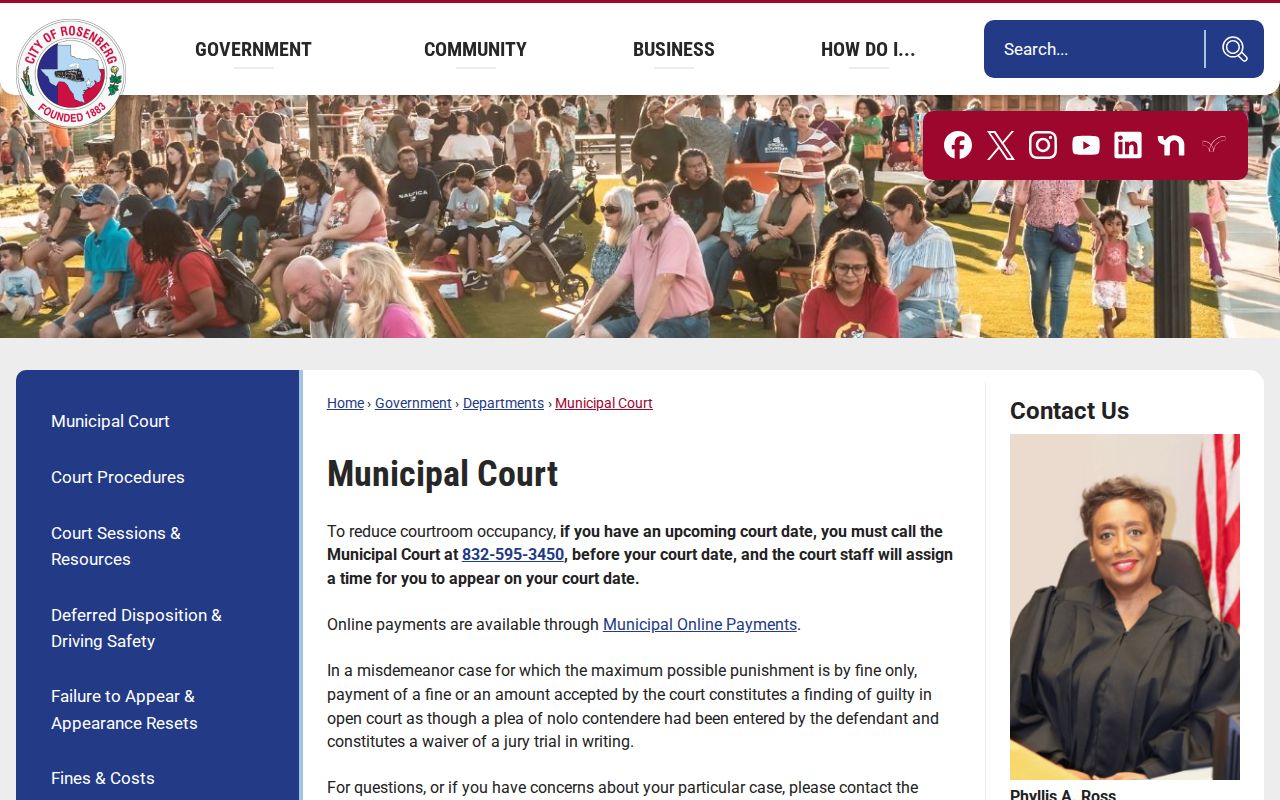
That page is a good orientation. For current hours, forms, and notices, reopen the official source before you act.
Why Rosenberg Assigns Appearance Times
Rosenberg asks court users to call before the court date. Staff assign the appearance time then. The printed date and that assigned slot work as a pair. Treat the date as an all-day invitation and you may arrive outside the scheduled period. Rely only on a remembered phone call and you could miss a written change.
Before court: Keep the citation in hand, call the clerk, write down the assigned time, and ask whether any later notice supersedes it.
This local scheduling quirk makes the municipal clerk more valuable than any generic county calendar. It also explains why the lack of a public search portal should never be patched with a guess. The clerk holds Rosenberg's live appearance information.
Finding Rosenberg Court Dates
Begin with the date printed on the citation. Then get the staff-assigned appearance time. A reset moves the setting; it does not dismiss the citation. Anyone seeking a new date should contact the court directly rather than assume a downloadable reset form exists.
| Date | The citation or current notice date for the Rosenberg proceeding. |
|---|---|
| Time | The appearance time assigned by municipal court staff after contact. |
| Courtroom | The room or city location named by the court for the session. |
| Judge | The presiding or assigned municipal judge shown for that docket. |
| Setting Type | Appearance, plea, trial, compliance, or another municipal event. |
If a date changes, keep the confirming notice or transaction record. A payment page, a form download, or a sample docket is not a live calendar.
People Listed on Rosenberg Dockets
The sample docket names the judge, prosecutor, clerk, and bailiff at the session level. Each role does different work. The judge presides. The prosecutor represents the city. The clerk keeps the record. The bailiff keeps order. None of that tells you what happened in any individual case.
- Judge
- The judicial officer presiding over the listed municipal session.
- Prosecutor
- The lawyer presenting the city’s case.
- Clerk
- The official maintaining docket entries, filings, and dispositions.
- Bailiff
- The officer supporting security and courtroom procedure.
Use those role labels to read the header apart from the defendant, citation, offense, and disposition rows. That habit keeps the session roster from being mistaken for party information.
Rosenberg Traffic Ticket Lookups
A Rosenberg police citation within municipal jurisdiction belongs with the city court. Verify the printed court and citation number first. Then call for the assigned appearance time or status. The municipal-online-payments link works for an eligible payment. But it is not a full public docket index. Rosenberg warns that paying generally counts as a guilty or nolo plea. It also waives a jury trial.
If you plan to contest the charge, follow the plea and trial instructions instead of treating payment as a harmless lookup step. The city also posts forms for driving-safety-course and deferred-disposition requests. Check eligibility and required documents on the current form. The Fort Bend traffic court resource explains how municipal and Justice Court citations differ.
Rosenberg Court Forms and Changes
Rosenberg's city forms handle driving safety and deferred disposition. Expect fields for your name, citation, signature, and contact details. Add any license or insurance paperwork that applies. Put those identifiers in the official submission channel, never in public notes. Keep your own copy plus proof the court received the form.
Form availability shifts. The reset form has been unavailable. That is a good reason not to lean on an old bookmark or a downloaded copy from months back. Ask the court administrator for the current reset method, the deadline, and what approval it needs. A reset you request does nothing until the court acts and confirms the new setting.
How Rosenberg Cases Reach the County
Most fine-only and code cases stay put in Rosenberg Municipal Court. A Fort Bend County docket only comes into play when the law sends a matter there. An authorized later filing can do the same. Appeals are the common trigger. If an appeal builds a County Court at Law record, keep the original citation and the municipal disposition close at hand. One more wrinkle: the city file and the county file sit with different offices, and they may carry different numbers too.
Docket flow: Rosenberg Municipal Court › Fort Bend County Courts › Fort Bend County District Courts
Treat this as a jurisdiction map, not a promised route. Fort Bend County Courts at Law hear the statutory limited-jurisdiction matters. The District Courts take the higher-level cases. For county-level search routes, the Fort Bend County court docket overview helps. It complements, not replaces, Rosenberg's municipal clerk.
Rosenberg Dated Fine Schedule
The Rosenberg Fines and Costs page points to a schedule effective September 1, 2025. That date matters. Fine amounts and court costs shift over time. So always work from the current official schedule and ask the clerk for the exact total tied to your citation. Skip undated summaries, and never assume every offense costs the same.
A payment amount and a disposition are related fields. But they are not the same thing. The amount is what the system calculates. The disposition is what the court records after a plea, trial, dismissal, or other action. Keep your receipt, and check the docket later if you ever need proof of resolution.
Who Can See Rosenberg Court Records
For a disposition letter or a case-file request, Rosenberg's court or city open-records channel is the fallback. Judicial records go through the municipal clerk, while administrative material may fit the city public-information process instead. One caution: a public docket heading does not unlock sealed, confidential, juvenile, restricted, or redacted content.
Key rules:
Texas Rule of Judicial Administration 12 generally opens judicial records to inspection during regular hours, subject to exclusions and exceptions.
Texas Government Code Chapter 552 governs governmental information but does not replace the court-record request route.
Texas Family Code Chapter 58 limits access to protected juvenile information.
Requesting a copy works best when you name the citation number, the date range, and the exact document you want. The Rosenberg clerk can confirm the current status of a case and whether copies are available.
Reading Rosenberg Offense Fields
A Rosenberg court docket lines up several fields in one place. You get the offense, its abbreviation, the offense date and time, the police department, plus the citation and docket numbers. The abbreviation is just a short court label. It does not spell out the full legal allegation. If a code leaves you guessing, ask the clerk for the filed charge description. The docket entry will start to make sense.
Dates need care too. The offense date is when the conduct allegedly happened. That is not the filing date, the court date, or any later entry on the docket. Keep each date separate and a clear timeline takes shape. The police-department field names the agency tied to the citation. The court heading tells you which municipal court actually holds the file. That difference matters when you make a records request, since an agency report is not the same thing as the court's own file.